

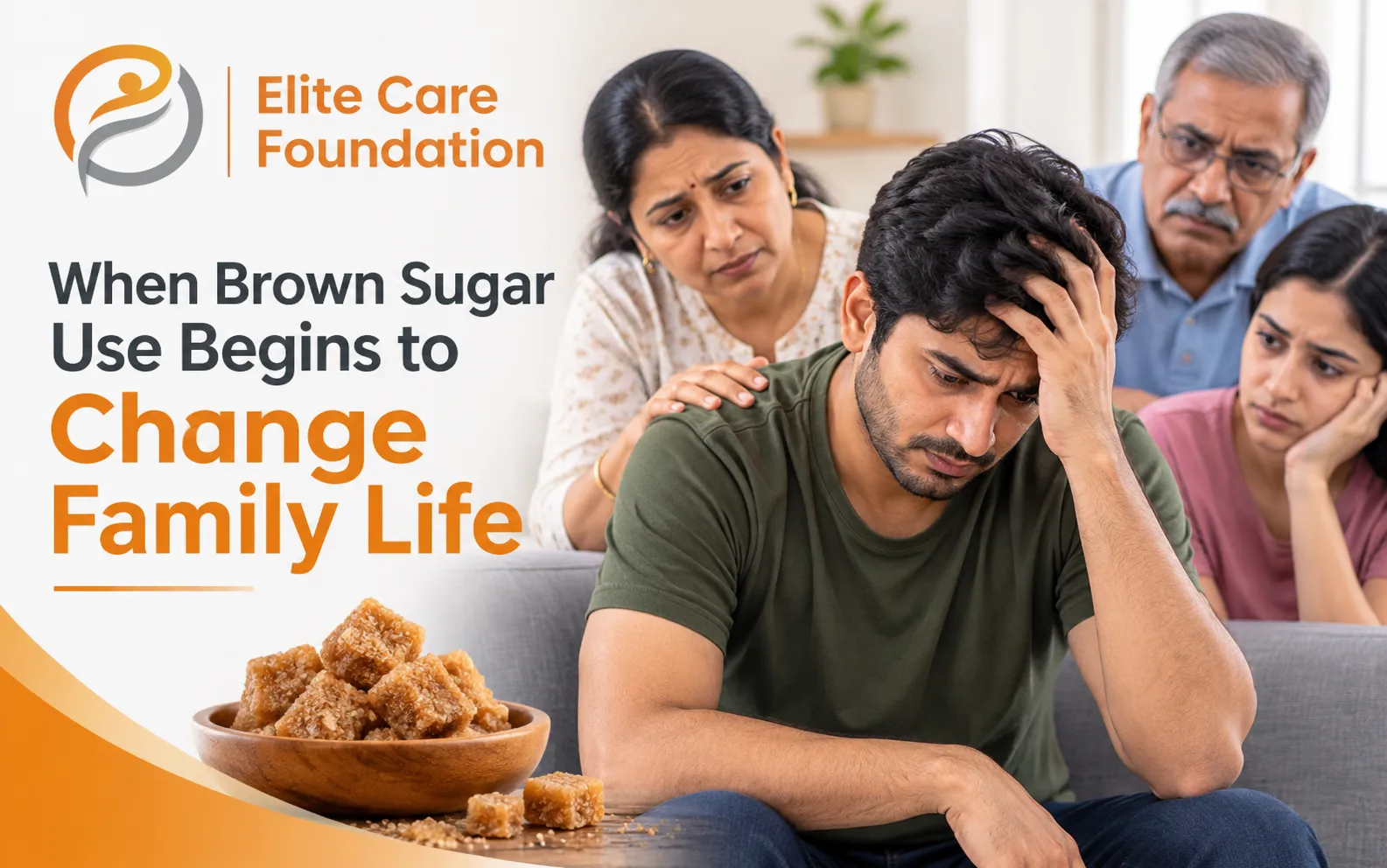
Families often describe the worry before they describe the substance. Someone has stopped turning up for work. Money keeps disappearing. A son who used to join everyone for dinner now spends most evenings behind a closed door. None of these details confirms drug use. Together, however, they may be enough to justify an honest conversation and a medical assessment.
In India, the street name brown sugar usually means heroin, an opioid. It does not tell a family what is actually in a packet, how strong the product is or whether other drugs have been mixed into it. Treating the name as a reliable description can lead to dangerous assumptions, especially when a person is very drowsy or has difficulty breathing.
Changes worth discussing, not charges to prove
Early conversations tend to revolve around behaviour: repeated requests for money, unexplained absences, drowsiness, changes in sleep or neglect of responsibilities. None of these signs proves heroin use. Stress, depression, another illness or a different substance can produce similar changes. A respectful medical assessment is more useful than an argument built on suspicion.
Before accusing someone, it helps to look at what has changed over several weeks. Have attempts to stop lasted only a day or two? Has the person begun feeling ill when they go without the substance? Are they keeping appointments, eating regularly and managing their money? The answers may point towards a need for assessment; they are not a diagnosis a relative can make at home.
A relative can say, “I am worried because you have missed work and have been unwell. Can we speak to a doctor together?” That is usually a better opening than a threat. Safety, however, comes first: violence, serious confusion, suicidal talk or an inability to wake the person warrants urgent help, not another family meeting.
Why the first clinical assessment changes the plan
The Ministry of Social Justice and Empowerment’s national substance-use survey, released in 2019, estimated that 2.26 crore people in India used opioids and approximately 77 lakh needed help for opioid-related problems. These figures describe the survey period, not a current count, but they show why opioid care cannot be reduced to a matter of willpower.
A clinician needs to know what was taken, when it was last used, whether alcohol or sedative tablets are involved and whether there have been overdoses. Existing medical and mental health conditions matter too. Someone who has become dependent may experience body aches, stomach symptoms, sweating, agitation and powerful cravings when opioid use stops. Withdrawal can be extremely distressing even when it is not the same medical emergency as alcohol or benzodiazepine withdrawal.
A rehabilitation centre is worth assessing on the care it can provide, not only the promise of a room away from drugs. Ask who carries out the first medical examination, how mental health concerns are recognised and what happens when a patient needs hospital treatment. Withdrawal care, continuing therapy and the period after discharge all deserve attention.
Detoxification is a beginning, not a complete treatment
The World Health Organization identifies medicines such as methadone and buprenorphine as effective options for opioid dependence when clinically appropriate. These treatments are not simply replacements chosen by a family. They require an individual assessment, qualified prescribing and follow-up. Access and suitability depend on the clinical setting and local arrangements.
This matters because a period without opioids can lower tolerance. If somebody returns to a previously used quantity after abstinence, the risk of overdose may be greater. Treatment that stops at detoxification can leave that problem unaddressed. Continued care may include medication, counselling, support for co-occurring mental health difficulties and a clear plan for responding to recurrence of use.
When comparing options for brown sugar addiction treatment, ask the clinician what the next three months might look like, not just the first three days. Who will review medicines? Can the person attend follow-up appointments? What is the plan if cravings return or the family notices worrying behaviour? Specific answers are more useful than assurances about a permanent cure.
The family has a role, but not the whole responsibility
A family’s support matters, but it has limits. Relatives can accompany someone to an appointment, help with meals and transport, and agree to pay a treatment bill directly rather than hand over unrestricted cash. They should not be expected to diagnose withdrawal, administer unprescribed medicines or monitor another adult every hour of the day.
It also helps to agree on ordinary boundaries: financial support may be directed towards treatment and living needs, rather than handed over as unrestricted cash. Children should not be placed in the role of supervisors or messengers. Any family member who is frightened or exhausted may need support in their own right.
When to seek emergency help
If someone is unconscious, cannot be awakened or is breathing slowly or irregularly, suspect an overdose. Call India’s emergency number 112 or seek an ambulance immediately. Give naloxone if it is available and you know how to use it, follow emergency guidance, and remain with the person. Do not assume that sleep will solve the problem.
Getting help does not require a perfect family meeting. It may start with a ten-minute conversation, a visit to a qualified doctor or an agreement about what to do if breathing becomes abnormal. People recover at different speeds. What matters today is replacing guesses with sound information and arranging care that continues after the immediate crisis.